
Revisiting Nuclear Cyclops: A Vision, Re-entered
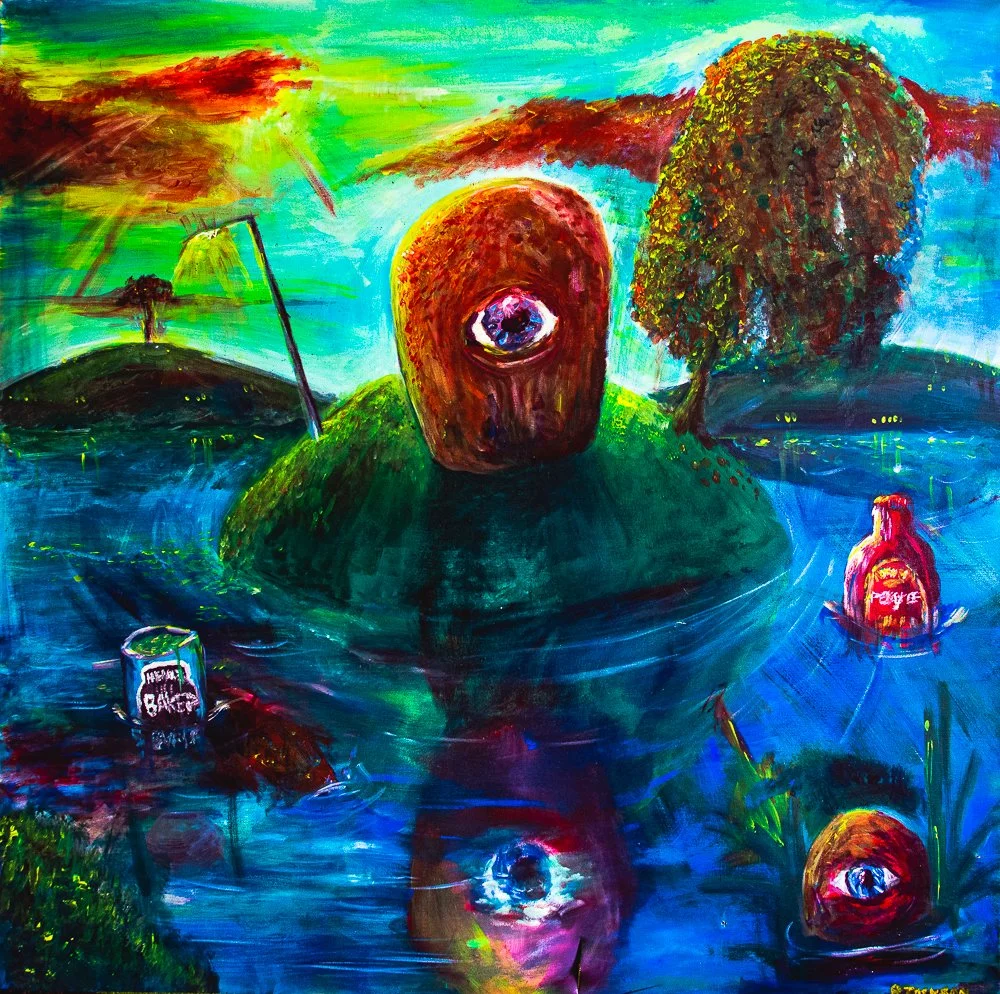
This painting has been with me for a long time. Nuclear Cyclops isn’t something I made recently; it’s something I painted years ago, and I’ve carried it with me ever since. It’s one of those works that never really leaves you alone. You don’t think about it all the time, but it’s always there somewhere in the background, quietly waiting. I painted it after a vision I had while I was out walking one day, and I still remember exactly where I was when it happened. The image arrived fully formed, and painting it was simply a way of grounding it, of giving it somewhere to live.
Over the years, I’ve looked at that painting many times. Sometimes it felt finished, sometimes it felt unresolved, and sometimes it felt like it was holding more than it was showing. Recently, I found myself returning to it again, not with the intention of changing it, but of listening to it differently. There was a sense that the image wasn’t limited to the surface, that it hinted at depth and atmosphere that I hadn’t been able to reach at the time I first painted it.
That’s where AI came in, not as something new layered on top of the work, but as a way of revisiting it. Almost like stepping back into an old room and seeing it with different light. Using AI allowed me to extend the painting into something more cinematic and immersive, to deepen the colours, the space, the mood. It didn’t replace the original image at all. If anything, it brought me closer to how the vision had originally felt, before it became fixed in paint.
From there, the work naturally moved into motion. Turning the image into a video allowed me to spend time inside it rather than just look at it. I could move around, pause, observe, and let the atmosphere settle. Details began to emerge that I hadn’t consciously planned, but which felt completely right. The eye felt more present, the water heavier, the space more alive. It wasn’t about narrative or explanation, just about staying with the image long enough for it to show itself again, this time as a living environment rather than a memory.
Working this way also brought back a lot of older feelings for me. As a child, I was fascinated by strange, uncanny things, especially the coin-operated machines you’d find at seaside arcades. Those small glass tanks where, for a few seconds, a creature would rise out of murky water before sinking back again. They were brief moments, but they carried a huge sense of wonder. They suggested hidden layers beneath the everyday world, places you could glimpse but never fully enter.
That fascination never really left me. Monsters, mutants, anomalies, cryptozoology — they’ve always felt less like horror and more like gateways. Ways of understanding reality when it’s under pressure, when it mutates, when it slips slightly out of alignment. Looking back now, I can see that Nuclear Cyclops, and the way I’ve returned to it through AI, sits firmly in that same lineage. It’s not about making something new for the sake of it, but about re-entering a vision that’s been quietly waiting, and allowing it to speak again in a different form.