
The Rose in the Darkness
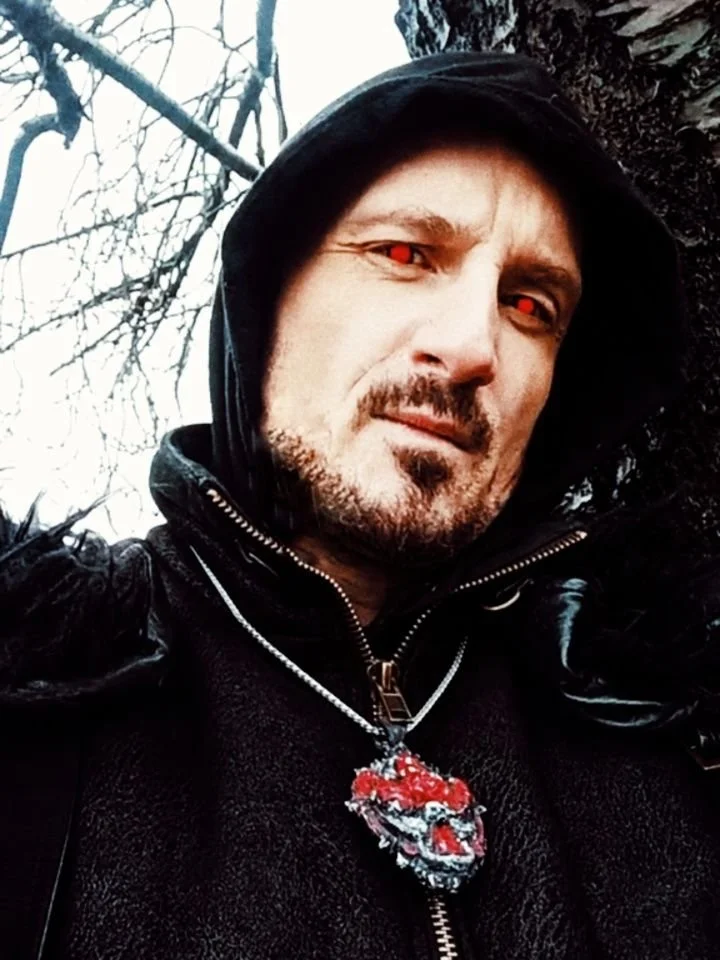
Between the Rose, the Cross, and the World
I do not define myself as a Rosicrucian in any formal or institutional sense. I don’t belong to an order, a lineage, or a creed. Yet there are aspects of Rosicrucian thought that resonate deeply with me — not as belief, but as experience.
What draws me is not doctrine, but vision: the imagination as a perceptive faculty, the inner eye, the capacity to see worlds within the self. The esoteric landscape that exists not above life, but inside it. This is where Rosicrucianism meets my own path — not through Lutheran moral reform, but through a Luciferian current of self-illumination. Not rebellion. Not worship. But understanding.
For me, illumination is not ascent away from the human condition. It is the ability to move within it consciously — to explore imagination and shadow with maturity and restraint. To walk a liminal path where inner vision and earthly presence remain in balance. When that balance is lost, illumination collapses into fear, paranoia, or inflation. When it is held, it becomes art, insight, and responsibility.
Alchemy, as I experience it, is not metaphor alone. It is lived through states of being. The Nigredo — the black stage — where illusion dissolves, where the shadow is encountered honestly, where identity breaks down. And the Rubedo — the red stage — where insight returns to the body, to love, to creative expression. These stages are fundamental to my work and to the inner world I call Romeria.
Romeria is not an escape from reality. It is a transmutation of it. A world that exists between perception and imagination, between the seen and the sensed. In Rosicrucian symbolism, the rose blooms at the centre of darkness. In my work, Romeria is that rose — red, alive, luminous — surrounded by blackness that does not threaten it, but gives it depth.
The Cross Beyond Reduction
For many modern Christians, the cross is understood primarily as an instrument of torture — a symbol of suffering alone. While that history matters, it feels incomplete. Within Rosicrucianism, Christian mysticism, and older occult traditions, the cross carries a far deeper meaning.
To me, the cross is a structure of groundedness and orientation. Its vertical axis resembles a tree or world-spine, rooted in the earth and rising toward the heavens. Its horizontal arms extend outward into relationship, multiplicity, and the world. It is a meeting point — of above and below, inner and outer, spirit and matter.
This symbolism did not begin with Christianity. The Celtic cross, deeply connected to pagan and Druidic traditions, already carried solar, elemental, and directional meaning long before it was absorbed into Christian iconography. Christianity did not invent the cross — it inherited and re-interpreted it.
This is why the cross remains essential to Rosicrucian symbolism for me, even from a Luciferian perspective. It is not a denial of illumination, but its necessary ground. Without the cross, light becomes abstract. Without grounding, vision becomes dangerous.
The cross encodes the four elements:
earth — structure, body, incarnation
fire — illumination, consciousness, inner sun
water — emotion, depth, transformation
air — thought, symbol, breath
To understand light is to understand how these elements interact — not to escape them. This elemental balance is central both to Rosicrucian alchemy and to the world of Romeria, which is built from light and shadow moving throughelemental forms, not beyond them.
Although Rosicrucianism historically aligns itself with Christianity and Christian mysticism, I do not reject this inheritance. I have never denounced the power of Christ — whether understood as Logos, symbol, archetype, or historical man. Christ, for me, remains part of the flame: an embodiment of love, conscience, and incarnation. Illumination without compassion is dangerous. Compassion without vision is blind. I refuse to sever the two.
What I resist is reduction — the flattening of symbol into dogma, the stripping of mystery from forms that once carried cosmic meaning. Many are denied the sight of how complex and beautiful these symbols truly are. Rosicrucianism matters to me because it preserves this deeper vision — where the cross is not merely about death, but about how light survives incarnation.
To see more is not to rule.
To imagine more is not to escape.
To be illuminated is not to ascend.
It is to remain human — with eyes open.
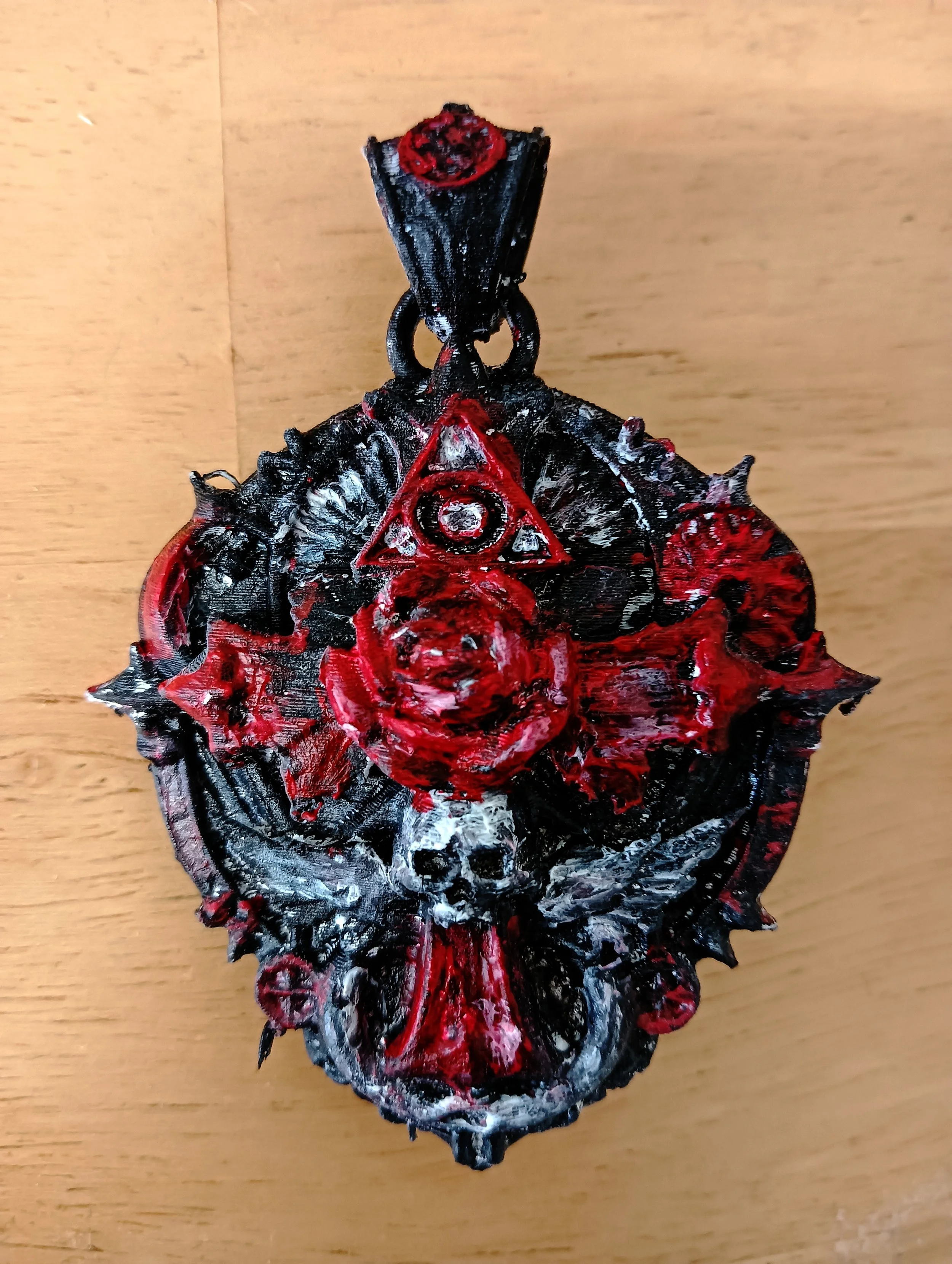
This pendant exists as an object before it exists as an explanation.
It was shaped to be worn, not declared. To be noticed, perhaps, but not announced. Its meaning is not fixed, nor does it ask to be understood immediately. Like all true symbolic objects, it works slowly — through attention, curiosity, and inner recognition.
At its centre is the rose. Not a decorative rose, but one rooted in depth. In esoteric tradition, the rose represents inner development — the soul unfolding through experience, feeling, and pressure. It does not bloom in comfort. It ripens through darkness, patience, and exposure to what is difficult to face.
Surrounding the rose is shadow. This darkness is not negation or evil, but the ground from which illumination emerges. It reflects the underworld of imagination — the unseen realm where symbols form before they are rationalised, where intuition precedes explanation. This is the realm many avoid, yet it is the source of creativity, transformation, and insight.
Within this darkness lies the principle of the Black Sun — the hidden sun, the inward light. Unlike the visible sun, which illuminates outwardly, the Black Sun radiates inward. It is the furnace of imagination, the womb of vision, the place where light is gestated rather than displayed.
This is the alchemical heart of the pendant.
Light and shadow are not in conflict here. They depend on one another. Without shadow, light has no contrast. Without light, shadow has no form. True alchemy does not eliminate one in favour of the other — it integrates both. This balance is not moral, ideological, or theatrical. It is structural. It is how inner transformation actually occurs.
The eye within the pendant represents perception rather than authority. It is not an all-seeing symbol of dominance, but a reminder that seeing is an inner act. Vision develops through attention and experience. To see more deeply is not passive — it reshapes the one who sees.
The wings are not symbols of escape. They suggest movement between realms — between surface and depth, seen and unseen. Illumination here is not ascent away from the world, but engagement with it: feeling more, perceiving more, holding complexity without collapsing it into certainty.
As an object, the pendant does not instruct or persuade. It does not belong to an order, nor does it ask allegiance. It is an illuminated key — not because it opens something externally, but because it reflects an inner readiness.
Some will notice it and pass by.
Some will feel drawn without knowing why.
Some may feel unsettled.
All of these responses are meaningful.
The pendant does not reveal itself through explanation. It reveals itself through encounter. Through being worn. Through being seen. Through the quiet questions it provokes rather than the answers it gives.
It is a reminder that imagination is not fantasy, that darkness is not absence, and that illumination often begins where certainty ends.
The rose glows because it has passed through shadow.
The light exists because the darkness holds it.
And the key waits — not to unlock everyone, but to meet those already listening.