
Abomination in a tank
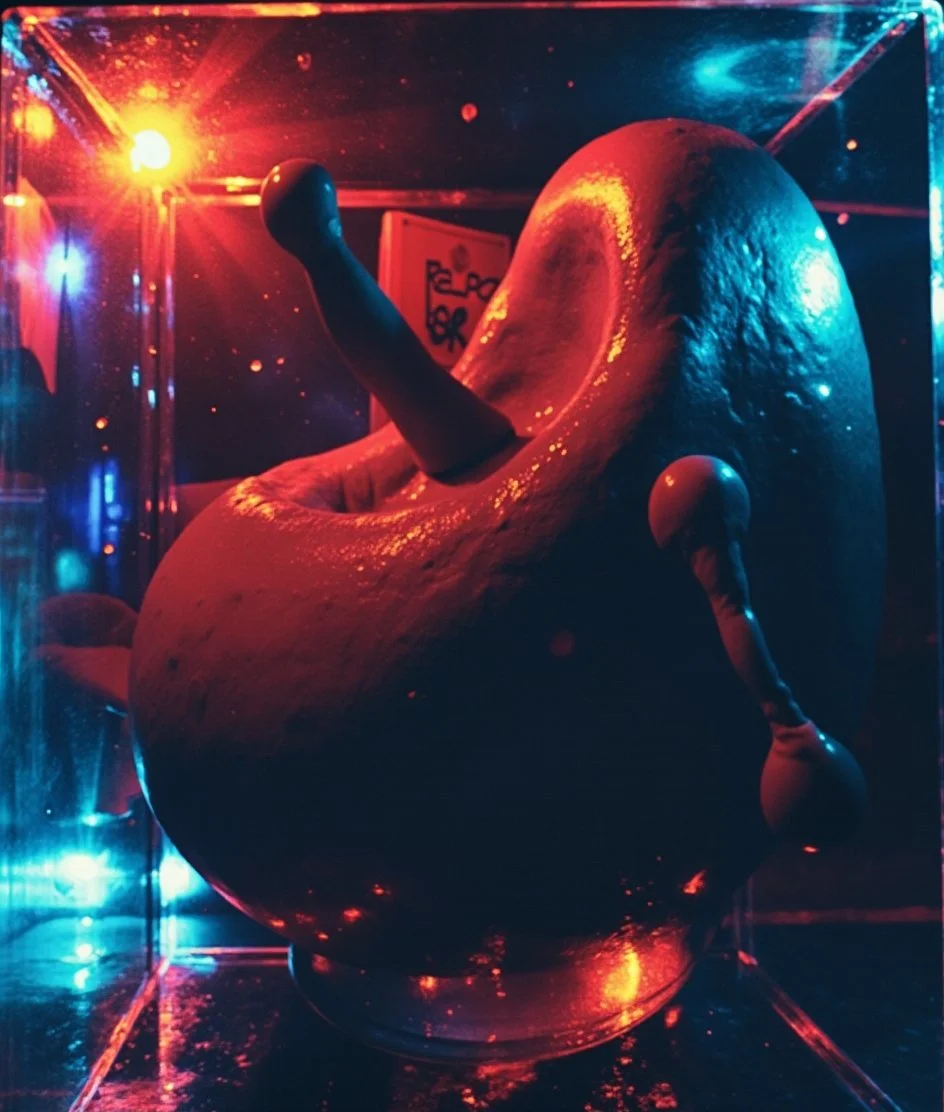
The figure in this image is difficult to categorise. It is organic, soft-bodied, mutated — something biological that no longer fits into any recognisable order. It doesn’t belong in the cube that contains it, and yet it has been placed there anyway.
The container doesn’t feel protective. It feels archival. Like an object removed from circulation and quietly set aside — not destroyed, but no longer permitted to exist freely. There is no obvious liquid suspending it. It appears isolated, hovering or suffocating within a sealed chamber. Lit, observed, but still somehow unseen.
The atmosphere is not one of violence, but of removal. Observation rather than care. Preservation rather than belonging. The cube becomes less a vessel and more a boundary — a place where something unclassifiable is held because there is nowhere else for it to go.
At the time this image took shape, I recognised something familiar in it. Not because I see myself as the figure, but because I recognised the condition around it. There was a long period where my work existed in isolation — created privately, without audience or acknowledgement. Years of producing quietly, while the world outside seemed indifferent to the act of making itself.
It wasn’t dramatic. It was muted. Ordinary. And deeply lonely.
The image reflects that atmosphere rather than an identity — the experience of being set aside within a culture that struggles to recognise what does not conform to its expectations of usefulness or normality. Something is not rejected outright, but gently archived. Preserved, yet excluded.
One of the most beautiful aspects of this way of working is that I no longer feel positioned purely as the creator. I feel like the audience as well. The process has become porous. The image doesn’t arrive obedient to intention — it emerges through uncertainty. I never fully know what the outcome will be, and that not-knowing has become essential.
For me, this is where art stays alive. The moment control becomes absolute, the work turns synthetic. It may look complete, but something vital drains away. Life needs space to misbehave.
I’m less interested in constructing images than in creating the conditions where something unexpected can surface — where form remains fluid, meanings remain unsettled, and the work feels as though it has slipped briefly out of the physical and into something more atmospheric. In that sense, the image becomes a meeting point rather than a statement. I encounter it much like anyone else might — slowly, intuitively, without certainty.
If there is a moral within this image, it isn’t about monstrosity or rejection. It’s about deprivation.
Much of our existential pain arises when the creative impulse is denied space to breathe — when expression is reduced to usefulness, and imagination is treated as excess rather than nourishment. Creativity is not a luxury or a reward for a chosen few. It is a fundamental human function — a way of processing experience, of making sense of being here at all.
Every person carries something that wants to be illuminated. Not necessarily celebrated or monetised, but simply seen. Outside of labour. Outside of roles. Outside of expectation. When that impulse is denied, people do not become broken — they become unseen.
This work has been a way back for me. A means of moving through isolation rather than around it. And if it offers anything beyond itself, I hope it is this: an encouragement to find your own forms, your own methods, your own permissions — especially in the places where expression has been quietly discouraged.
What is denied expression does not disappear.
It waits.
Creation, in whatever form it takes, remains one of the few ways we have of letting what waits inside us finally speak.