
A Deep Puddle — A Noetograph
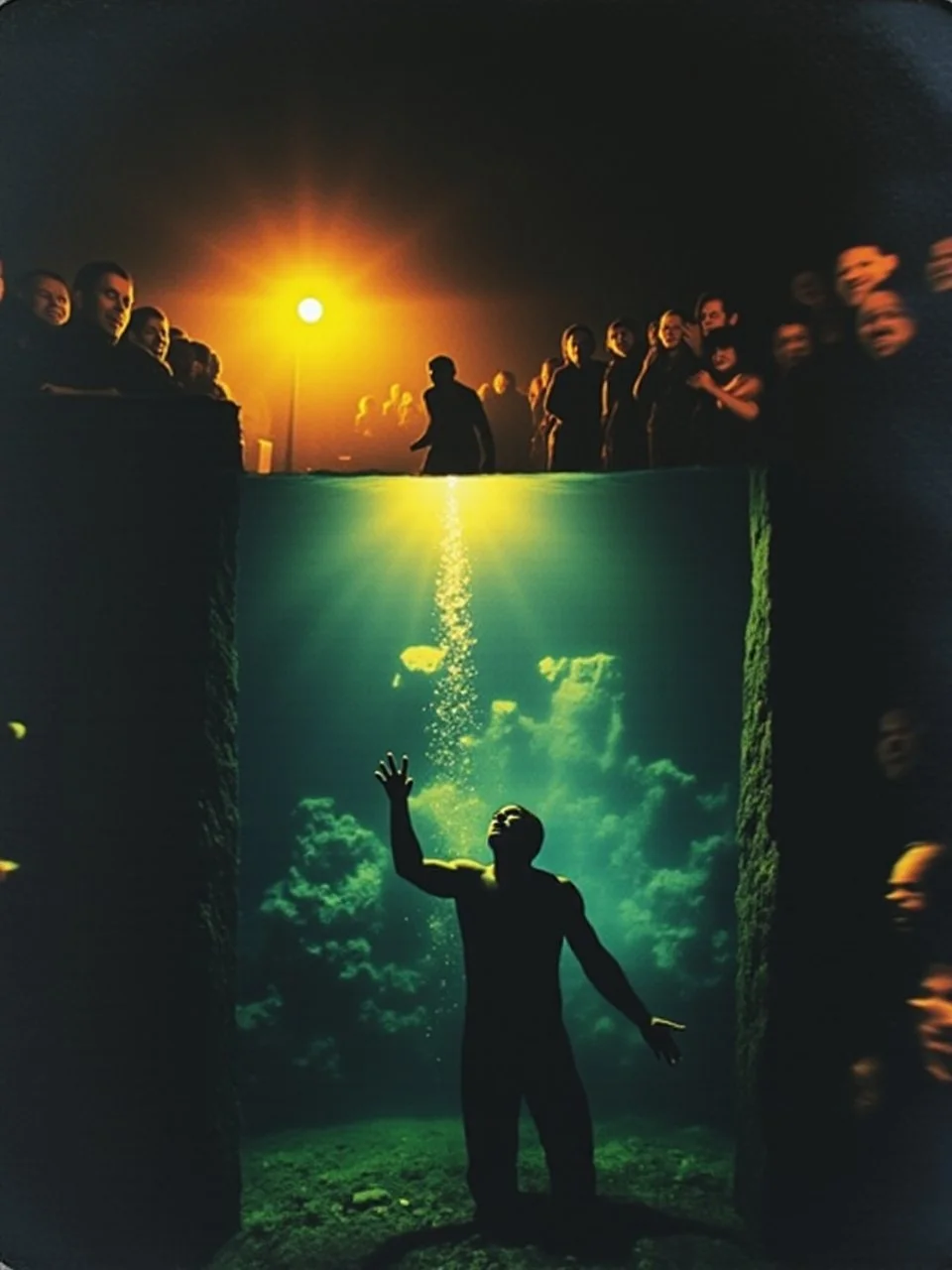
The Puddle of the Deep Mind Noetograph
In this illusionary imaginism photograph, we are presented with what appears to be an alternate world — though the longer one looks, the harder it becomes to decide whether it is alternate at all.
The upper portion of the image is crowded and unstable. A group of people gathers at the surface, caught in harsh light and partial blur. Their faces and bodies overlap, compressing into a restless mass of movement and expression. There is laughter, noise, animation — yet it feels strangely hollow, distorted, almost frantic. The scene suggests life lived at a pitch that never settles, a social choreography that repeats itself without reflection. The figures appear animated, but not necessarily awake, their presence fragmented by light, proximity, and distraction.
Below the waterline, the atmosphere changes completely.
A solitary man floats within a submerged space — a deep, watery chamber that feels less like danger and more like suspension. He is not simply sinking, nor clearly rising. His body is caught in a slow negotiation with gravity and pressure, as if something both invites him upward and gently resists his ascent. Light glows softly beneath him, illuminating drifting particles and creating a sense of interiority, of a place that holds rather than expels.
The water feels liminal — neither abyss nor refuge, but something in between. A zone of altered perception where movement slows and awareness thickens. The man appears to be orienting himself within this depth, not panicking, but adjusting, listening, testing his balance between surface and descent.
What adds to the unease is the presence of spectators within this lower realm. Distorted figures appear beyond the glass-like boundary of the water, observing the man as if he were contained, exhibited, or studied. The scene evokes the strange disquiet of aquariums or viewing tanks — places where living beings are suspended behind transparent barriers for observation. Here, the roles feel uncertain: is the man the subject of curiosity, or are the watchers themselves part of the enclosure?
This ambiguity is central to the image. No single position feels secure. The surface world appears animated yet unstable; the depths appear quiet yet exposed. The photograph refuses to clarify where safety lies, or whether escape is even the correct instinct. Instead, it holds the viewer in a suspended state — caught between spectacle and solitude, noise and silence, surface and depth.
The result is an image that unsettles not through overt drama, but through dislocation — a quiet sense that something about this arrangement of worlds is familiar, intimate, and deeply unresolved.
On Illusionary Imaginism
This work functions as Illusionary Imaginism because it does not depict a fantasy world, nor does it document a real one. Instead, it renders an inner psychological condition with the visual authority of a photograph. The scene feels observable, almost documentary, yet what it records is not an external event but a state of being — a tension between surface life and inner depth.
Illusionary Imaginism operates by giving imagined or interior realities the weight, texture, and credibility of lived experience. The image does not ask to be believed as fiction, nor accepted as symbolism. It presents itself as something witnessed — an encounter rather than an illustration. In doing so, it bypasses explanation and speaks directly to recognition.
What matters here is not whether the world shown exists, but that it feels as though it could — because the psychological terrain it reveals is already familiar, even if rarely acknowledged. The illusion lies not in deception, but in making the invisible legible.