
The Flatness of Exoteric De-illumination
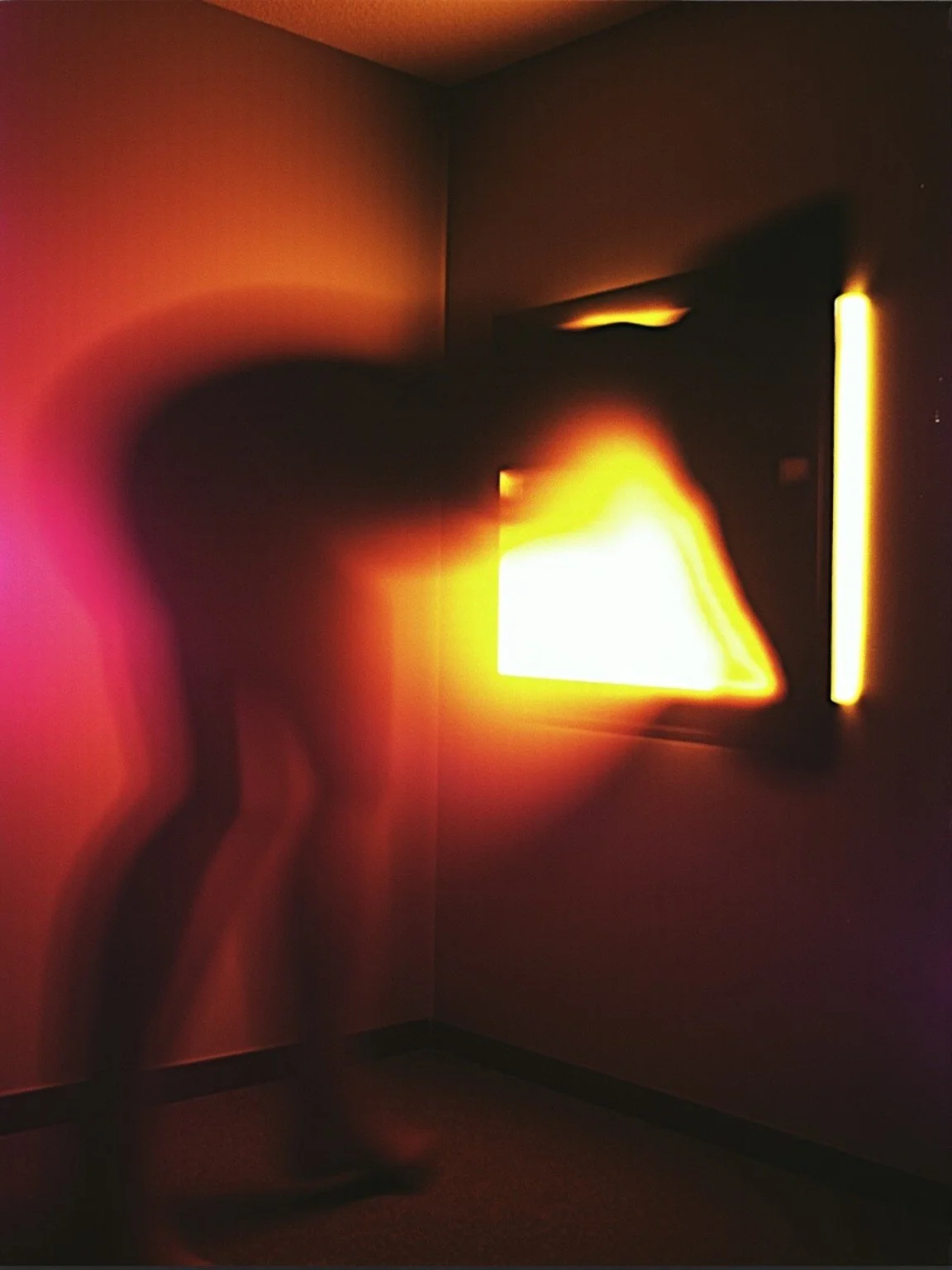
The photograph reveals a condition rather than a moment.
At first glance, it appears softly lit, even warm. Colour fills the space with a familiar modern glow. Nothing seems hostile or overtly bleak. And yet, there is a subtle sense that something essential is missing — not removed violently, but quietly withdrawn.
At the centre of the image stands a human figure that does not fully resolve. The body is blurred, thinned, partially detached from itself. It is difficult to tell who this being is, or even whether they are still inwardly present. The figure remains upright, functional, participating — yet hollowed, as though the inner ground that once held it has receded.
This is not collapse.
It is de-illumination.
Not darkness, but the loss of inner light. Not ignorance, but a narrowing of perception. A movement away from the esoteric landscapes of inward vision and into a world lived almost entirely from the outside.
The glow that surrounds the figure is not illumination in any sacred or imaginal sense. It is false light — the sheen of the exoteric world: surfaces, signals, screens, shared appearances. A reality defined by what can be seen, agreed upon, and externally affirmed. Meaning is no longer entered inwardly; it is received from without.
This condition has existed before.
William Blake described it as single vision — not blindness, but a state in which reality is reduced to one plane only. The physical and literal are taken as the whole, while the inner worlds are dismissed as unreal, secondary, or childish. In this vision, imagination is no longer a realm of being, but a decorative excess.
What appears in the photograph resembles this same flattening — though rendered in contemporary form. Perception skims along surfaces. Depth is absent. The world feels complete, yet spiritually thin.
Children do not begin life here.
They arrive closer to the inner divine spark — closer to the flame. They seek magic instinctively, not as fantasy but as truth. They expect the world to be alive, responsive, layered, mysterious. For them, imagination is not entertainment; it is orientation. The inner worlds are not separate from reality — they are reality, experienced directly.
Yet this closeness does not last.
Children are initiated, slowly and repeatedly, into a different understanding of the world. They are taught what is “real” and what is not. The imaginal is dismissed. The magical is explained away. The inner spark is treated as something to grow out of rather than something to protect. What once felt alive is redefined as naïve.
This initiation does not arrive as cruelty.
It arrives as reassurance.
False hope replaces wonder. False belief replaces vision. The world offers certainty in place of mystery, comfort in place of meaning, explanation in place of experience. The magic is not attacked — it is gaslighted, until the child begins to doubt their own inner knowing.
What follows is a quiet estrangement from the inner flame.
The world they are initiated into increasingly reflects a flattened reality — one that is subtly nihilistic, subtly narcissistic, concerned with surfaces, validation, and self-image rather than depth, meaning, or inward truth. The inner life becomes embarrassing, impractical, or unreal. Attention turns outward. The spark dims, not because it dies, but because it is no longer fed.
This is how de-illumination takes hold.
The inner light does not go out.
It withdraws.
The figure in the photograph appears to inhabit the aftermath of this withdrawal. There is no violence here, no moral failure. Only adaptation to a flattened world. The being has learned to exist within exoteric reality, and in doing so has lost the density that comes from inward dwelling.
This thinning is not symbolic.
It is ontological.
When imagination ceases to function as an inner realm, creation itself becomes impossible. Thought begins to recycle. Desire repeats inherited patterns. Culture rearranges what already exists, endlessly animated yet inwardly unchanged.
Van Gogh saw this condition clearly. Where inner vision is absent, in that comfortable normality, but no flowers grow there. The landscape may be ordered, productive, even prosperous — but nothing truly alive emerges. The soil has been stripped of its imaginal depth.
The photograph carries this same barrenness beneath its colour.
It is not bleak, yet it does not nourish. It moves, yet it does not bloom. The world shown here is intact, efficient, convincing — but inwardly uninhabited.
This is the flatness of exoteric de-illumination.
A state in which the human being lives entirely on the surface of reality. Where perception no longer descends inward. Where imagination no longer opens worlds. Where meaning is inferred rather than experienced.